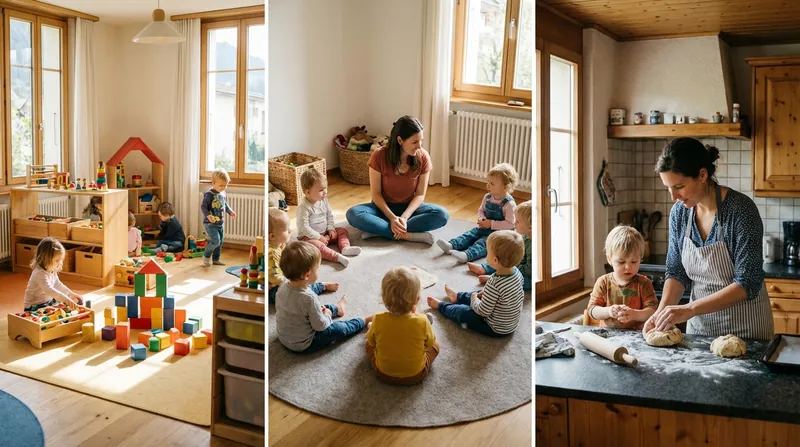
Daycare, Playgroup, or Childminder? The Complete Comparison
Daycare, playgroup, childminder — three forms of childcare that are fundamentally different. Which one suits your child, your daily routine, and your budget? This comparison helps you decide.
Comparison at a Glance
| Daycare (Kita) | Playgroup | Childminder (family daycare) | |
|---|---|---|---|
| Age | From 3 months | From approx. 2.5 years | From 0 years |
| Care hours | Full-day (up to 12 hrs) | Half-day (2–3 hrs) | Flexible (individual) |
| Frequency | 1–5 days/week | 1–3 half-days/week | 1–5 days/week |
| Group size | 12–22 children | 8–12 children | 1–5 children |
| Caregivers | Team (FaBe, HF diploma) | 1–2 group leaders | 1 person |
| Costs | CHF 100–150/day | CHF 14–25/half-day | CHF 5–12/hour |
| Subsidies | Often yes (municipality) | Rarely | Yes, through associations |
| Tax deduction | Yes | Yes | Yes |
| License required | Yes (cantonal) | No | Above a certain size |
| Meals | Yes (incl. or separate) | Usually a snack | Yes |
| Ideal for | Working parents | Kindergarten preparation | Flexible needs |
The Daycare Center (Kita)
What is it?
A daycare center offers professional full-day care for children from approx. 3 months until they start school. Children are cared for in mixed-age or same-age groups by trained staff. Daycare centers have fixed opening hours (usually 07:00–18:30) and are generally open year-round, with a few weeks of operational holidays.
Advantages
- Professional care by qualified staff (Fachperson Betreuung EFZ, dipl. Kindererzieher/in HF)
- Structured daily routine with an educational program
- Social contact with many children of the same age
- Reliable and predictable — fixed days and times
- Often subsidized — income-based rates
- Supervised and licensed — guaranteed minimum standards
Disadvantages
- Higher costs than other forms of childcare
- Waiting lists, especially in cities (6–12 months lead time needed)
- Less flexible for short-notice changes
- Larger groups — not ideal for every child
- Children get sick more often (risk of infection in large groups)
- Operational holidays — parents must organize holiday care themselves
Who is it ideal for?
The daycare center is particularly suitable for working parents who need regular full-day care on fixed days. Children who enjoy being with many peers feel comfortable here.
The Playgroup
What is it?
In a playgroup, children from approx. 2.5 years until kindergarten entry meet one to three times a week for half a day (2–3 hours). The focus is on free play: crafting, painting, singing, movement games, and social interaction. The playgroup is not full-day care but rather an educational offering to prepare children for kindergarten.
There are various types of playgroups: classic indoor playgroups, forest and nature playgroups, farm playgroups, music playgroups, and inclusive playgroups for children with special needs.
Advantages
- Affordable: CHF 14–25 per half-day
- Ideal for first experiences of separation from home
- Small groups (max. 8–12 children)
- Preparation for kindergarten (routines, rules, social behavior)
- Language development — especially important for non-German-speaking children
- Parent contact and advice as part of the offering
- Wide variety of concepts (forest, farm, music, etc.)
Disadvantages
- No full-day care — does not meet the needs of working parents
- Only available from approx. 2.5 years
- Not licensed — quality can vary
- Usually no subsidies (except in some municipalities)
- Some playgroups have long waiting lists
Who is it ideal for?
The playgroup is suitable for families who do not need full-day external care but want to prepare their child socially and linguistically for kindergarten. Particularly popular with families where one parent works part-time or is at home.
Good to know: In Basel-Stadt, children with little or no German language skills must attend a German-speaking playgroup, daycare, or family daycare for at least 3 half-days per week in the year before kindergarten.
The Childminder (Family Daycare)
What is it?
A childminder cares for children in their own home — individually or in a small group of up to 5 children. The care is more flexible than in a daycare center and can be individually tailored. Many childminders are employed by a family daycare association, which ensures quality assurance, training, and insurance.
Advantages
- Home-like environment — one or two consistent caregivers
- Flexible care hours, often also mornings, evenings, or on weekends
- Ideal for babies and very young children
- Small group — individual attention
- Often cheaper than daycare for part-time
- Care can start from birth (no minimum age)
- Children experience a normal family routine
Disadvantages
- Fewer social contacts with children of the same age
- Quality depends heavily on the individual person
- No substitute when the childminder is sick
- No mandatory training requirement (without association membership)
- Less structure than in a daycare center
Who is it ideal for?
A childminder is particularly suitable for babies and very young children who benefit from a small, home-like environment. It is also often the better solution for families with irregular working hours or the need for special flexibility.
Licensing rules for childminders: In Switzerland, a childminder does not need a license as long as they care for a maximum of 5 children at a time and no more than 2.5 days per week. Beyond that, a cantonal license is required. We recommend looking for a childminder through a recognized family daycare association — training, insurance, and quality control are guaranteed there.
Decision Guide: 5 Questions for You
How many days per week do you need care? Full-day on 3–5 days → daycare or childminder. Half-day 1–2x per week → playgroup.
How old is your child? Under 2.5 years → daycare or childminder. From 2.5 years → all three options.
What is your budget? Subsidized daycare is often the cheapest. Otherwise: childminder for a few days, playgroup as a supplement.
Does your child need a lot of one-on-one attention? Yes → childminder. No, enjoys large groups → daycare.
Is it primarily about care or kindergarten preparation? Care → daycare or childminder. Kindergarten preparation → playgroup.
Tip: Many families combine forms of childcare — e.g., 2 days daycare + 1 day childminder + 1 half-day playgroup. This is perfectly common and often the best solution.
«Switzerland has one of the most expensive childcare systems in the world. Transparency on costs and availability is the first step towards better work-life balance.»
More articles
Finding a Childminder: The Complete Guide
How to find the right childminder. About associations, costs, contracts, and what you should look for....

Playgroup: Everything Parents Need to Know
Playgroup from what age? Costs, types, and why playgroups are so important for kindergarten preparation....

Au Pair in Switzerland: Requirements & Costs
Au pair costs, legal rules, and the difference from a nanny: everything Swiss host families need to know....
Good Daycare: 10 Quality Criteria for Parents
How to recognise a good daycare? 10 evidence-based quality criteria, warning signs, and a printable checklist for parent...

Hiring a Nanny in Switzerland: Cost & Contract
Want to hire a nanny? Everything about wages, social insurance, contracts, nanny-sharing, and tax deductions as a privat...
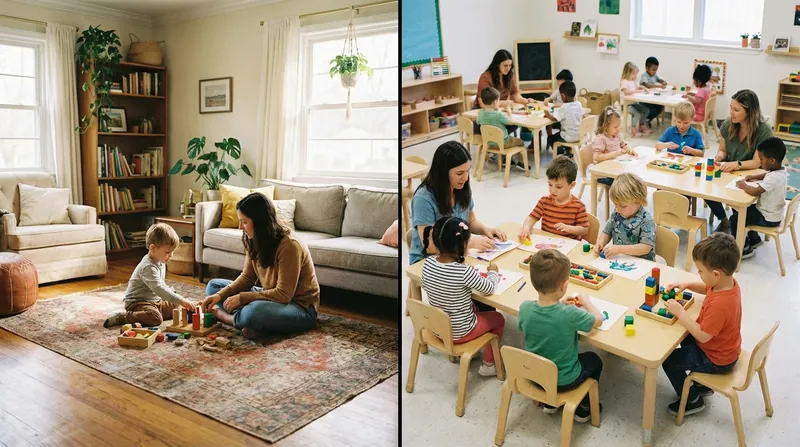
Day Family or Daycare? An Honest Comparison
Day family or daycare: costs, flexibility, staff ratios, and quality compared directly — plus tips for combination model...