
Daycare Settling-In: A Successful Start
The first day at daycare is a big step — for your child and for you. A good settling-in period is crucial for your child feeling safe and happy at daycare. Here you will learn how the settling-in works, what you can do, and what is normal.
Why Is the Settling-In Period So Important?
Young children need secure attachments. In the first years of life, parents are the primary attachment figures — everything new is explored from this secure base. The settling-in period gives your child time to get to know a new caregiver (the educator) and build trust, to explore the new environment while you are still there, and to gradually learn that you leave and come back.
A rushed or too-short settling-in period can lead to the child feeling permanently insecure. That is why good daycare centers deliberately take time for this — at least 1–2 weeks, often 3–4 weeks.
The Berlin Model: The Standard in Switzerland
Most Swiss daycare centers follow the Berlin Settling-In Model, which was developed in the 1980s at the Institute for Applied Socialization Research. It is based on attachment theory and is divided into four phases:
Phase 1: Foundation Phase (Days 1–3)
Duration: 1–2 hours per day
You come to the daycare with your child and stay in the room. You are the "safe harbor" — available but holding back. The key caregiver approaches the child gently and offers play activities.
Your role: Be there but don't push yourself forward. Let your child come and go. Don't try to entertain them — that is the caregiver's job. Do not sneak away when you leave at the end of the session.
Phase 2: First Separation (from Day 4)
Duration: 15–30 minutes of separation
After a few days, you try the first short separation. You say goodbye clearly and warmly and leave the room — but stay nearby (next room or at the door).
If your child cries: This is normal. The caregiver will try to comfort them. If the child calms down within a few minutes, the separation was successful. If not, you will be called back and another attempt will be made the next day.
Phase 3: Stabilization (Days 5–10)
Duration: Gradual extension of the separation time
The separation time is extended day by day. First 30 minutes, then an hour, then through lunch, then including a nap. The caregiver takes over more and more tasks (diaper changing, feeding, comforting) while you gradually step back.
Phase 4: Completion (from Days 10–14)
Signs that the settling-in is complete:
- Your child can be comforted by the caregiver when they are sad
- They show joy when they see the caregiver
- They play curiously and explore the environment
- They accept the separation — even if they cry briefly, they calm down quickly
Schedule: Settling-In Week by Week
| Day | What happens | Duration |
|---|---|---|
| Days 1–3 | Child + parent together at daycare | 1–2 hrs |
| Day 4 | First short separation | 15–30 min |
| Days 5–7 | Separation is extended | 1–2 hrs |
| Days 8–10 | Child stays through lunch (with meal) | 3–4 hrs |
| Days 11–14 | Child stays including nap | 5–6 hrs |
| From day 15 | Regular daily routine | Full care time |
Important: This is a guideline. Some children only need 5 days, others 4 weeks. Both are normal. Don't let yourself be pressured for time — not even by your employer. Talk to your employer about the settling-in period early on.
What to Do If Your Child Cries Every Morning?
It is completely normal for children to cry at drop-off during the first weeks. This does not mean they are unhappy — it shows that they have a strong bond with you.
What helps:
- Establish a goodbye ritual: Always say goodbye the same way. For example: hug, kiss, wave at the window. Short and clear — no sneaking away, no endless dragging it out.
- Bring a comfort toy: A familiar object from home provides security.
- Pick up on time: Keep your promise. If you say "I'll pick you up after the afternoon snack," then be there after the afternoon snack.
- Trust the caregiver: In the vast majority of cases, the child calms down within minutes of saying goodbye. Ask at pick-up how things went.
- Don't go back and forth: When you leave, leave. Coming back because the child is crying prolongs the pain for both of you.
When to raise the alarm:
If your child still shows strong separation anxiety after 4 weeks, consistently withdraws at daycare, does not eat and does not sleep — then talk openly with the daycare management. The settling-in plan may need to be adjusted, or a different setting may be needed.
Settling-In with a Childminder and Playgroup
The Berlin Model also works with childminders and playgroups — in adapted form:
Childminder: The settling-in is often shorter (1 week) because the environment is more home-like and only a few children are present. Still: don't rush it.
Playgroup: Many playgroups offer 1–2 trial half-days where a parent stays. After that, separation is practiced step by step. Since playgroups only last 2–3 hours, the settling-in is usually easier.
Checklist: Preparing for the Settling-In Period
- Block the settling-in time in your work calendar (at least 2 weeks)
- Clarify with your employer: Who handles the settling-in (mother, father, or alternating)?
- Pack a comfort toy or familiar object
- Prepare spare clothes, diapers, pacifier (if needed)
- Playfully prepare your child for daycare (picture books about daycare life)
- Reflect on your own anxieties — your child senses when you are uncertain
- Keep your phone nearby (in case the daycare calls)
- First week: Don't schedule any major appointments — stay flexible
Sources: Pro Juventute, kibesuisse, Marie Meierhofer Institut. Last updated: February 2026.
«Switzerland has one of the most expensive childcare systems in the world. Transparency on costs and availability is the first step towards better work-life balance.»
More articles

Daycare Tour: The Ultimate Checklist
What to look for during a daycare tour? The most important questions about organization, education, rooms, and costs....

Finding Daycare in Switzerland: Step by Step
How to find the right daycare place: when to register, what to look for, which questions to ask. A practical guide with ...

Child Sick: Can They Go to Daycare? Rules
Child sick — daycare yes or no? Clear rules, waiting periods, your rights as an employee, and emergency solutions for wo...
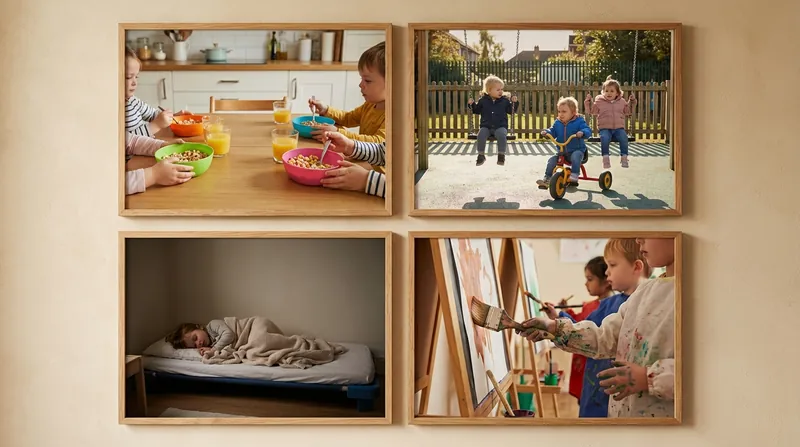
A Day at Daycare: What Your Child Experiences
From morning circle to snack time: what a typical daycare day looks like in Switzerland — with schedule, packing list, a...

Daycare Change or Move: Smooth Transition
Planning a move or unhappy with the daycare? How to make the change stress-free — incl. checklist and settling-in tips....

Daycare, Playgroup, or Childminder? The Complete Comparison
Which type of childcare is right for your family? Daycare, playgroup, and childminder compared side by side: age, costs,...